SDS-Website
Dominance Ideology and Hegemonic Decay[1]
Part I: The Economy
by Gretchen Dutschke
1. Dominance Ideology
The amazing success of George Bush up until now and the extreme policies of his advisors is the vexing affliction of this period. How could it have happened? What are the possible consequences? Is it coming to an end with the astonishing defiance of France, Germany and Belgium? What are possible alternatives?
Two lines of development are intersecting, bringing about what is likely to be the perfect storm unless it is averted. One strand has to do with the reconstitution of centers of international power after the fall of the Soviet Union. The other has to do with the fact that oil is a resource that is going to start getting scarce within the next decades, or maybe a bit longer if world economic stagnation lasts a long time. While not yet so directly in the public eye, the same is true for water.
After 1989 the various centers of policy studies in the US had to redefine what the US foreign policy goals were to be. At first glance it seemed that existing goals had been reached. The US no longer had anyone contending for the role of super power. US control of the world economy was not contested by any great powers. As a result some analysts (harking back to the Marxist idea of history ending - albeit with the classless society) boldly declared that we had reached the end of history with the victory of capitalism. Corporations were able to pretty much ask for and get whatever they wanted. Trade unions were almost abolished in the US and weakened or forbidden elsewhere, trade barriers lowered, environmental and worker and consumer protections could gradually be eroded.
How could it happen?
The exuberance of the sixties, the cultural revolution which occurred in many countries throughout the world changed how people behaved and opened the door to alternative notions of social development. (Oddly the term cultural revolution came from China where it was not a cultural revolution at all, but a means of destroying divergent political thinking.) In the developed nations there seemed at first to be a sufficient impetus toward more tolerance, more inclusive standards of behavior, more democracy and willingness to change.
But in the USA the power elites and religious fundamentalists were not inactive. The cultural revolution, esp. in the USA appeared to be a threat to corporations and to religious conservatives. The first and perhaps most important task for them was to annihilate the leaders of alternative movements. From the end of the sixties to the mid-seventies many of them were assassinated.
The movements themselves also had to be subverted and marginalized into radical fringe groups unappealing to the masses. Thus terrorism was supported by the intelligence services of most countries (through plants in organizations encouraging acts of terror), and the broad movement was sectarianized. That is not to say that it was the secret service which created terrorism or the Maoist and Stalinist sectarians. But the human proclivity to envy, dissention, greed and pugnaciousness was exploited to encourage developments of that nature.
At the same time, from the beginning of the seventies, the economy was stagnating. And the first oil crisis came in 1973. A batch of economists starting with Milton Friedman and his followers, who blamed the economic woes on government regulation and interventions in economic processes, on government programs to redistribute wealth, on the Keynesian concentration on government spending and relatively high taxes gained influence. The problem, they thought, was high wages and welfare, so they opposed lawmakers’ efforts to help the less well-off increase their consumption as a way to drive the economy forward. They propagated supply side economics, privatization, concentrating on increasing investment by capitalists, cutting corporations’ costs through wage cuts, less health and environmental regulation and increased productivity, and by making it easier for corporations to obtain raw materials in underdeveloped countries and selling products through trade. (Cutting wages could also cut consumption and thus make it more difficult for corporations to sell their products. This was successfully countered by huge increases in the income of the super rich who were able to vastly increase their consumption. It also required increased trade, so that elites in other countries could purchase products.)
Supply side economics got its first big chance in England with Margaret Thatcher. In the USA Ronald Reagan began the transformation after his election in 1980. The wave of privatization began. Reagan reduced taxes for the rich and created huge government deficits. Yet supply side economists are mostly convinced that this experiment was successful. During the 80’s the income of the richest 1% grew by 60% while the bottom 40% saw their incomes drop.[2] In 1997 the poorest 10 percent received 1.8 percent of total income, while the richest 10 percent got almost a third.[3]
For the first quarter of the 80’s the economy did not grow in spite of Reagan’s stimulus policies. But from the mid 80’s there was a rapid economic expansion which, however, negatively affected the living standards of 40% of the people. In other words the trickle down theory didn’t work.
After the stock market collapse in 1987, the economy once again stagnated and by 1990 was heading downward. George Bush the father thought he could stop the downward trend with a war - the first Gulf war in 1991. But that too did not work. After a short jump upward, the economy remained moribund.
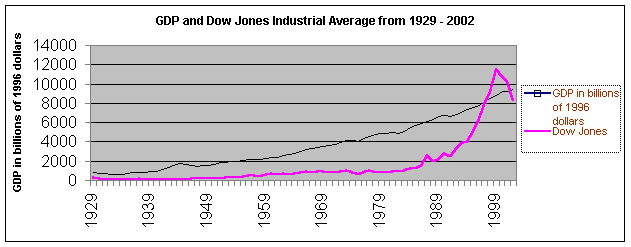
Let’s look at the idea that war stimulates the economy. This is a popular idea and the Bush government very much adheres to it. They point to history. But what does history show? If you use the Dow Jones to measure the health of the economy and many do, then you might question what you are measuring because the Dow Jones continually and quite arbitrarily changes the stocks it compiles. GDP is a measure of the total transfer of money for goods and services in the economy and thus might be a better indication of broader economic activity. The chart above[4] shows the growth in US GDP from 1929 to 2002 and changes in the Dow Jones for the same period. The US fought in several large scale wars from 1929 to 2002 - WWII, the Korean War, the Vietnam War (less extensive were the Gulf War and the war in Serbia).
During these wars, you can see (though not very well in this chart) that the stock market generally did go up a bit at the beginning of the war. But it did not follow through and for the most part there was a period lasting between one and seven years of little growth or negative growth after each of these wars. The stock market really grew only during long periods of peace. So if history repeats itself, we can expect that Bush’s war might jack up the stock market for a couple weeks, followed potentially by years of stagnation.
GDP on the other hand did grow significantly during the second world war. However, it fell back to its long-term trend line after the war. None of the other wars brought any changes in the rate of GDP growth, but there were periods of no growth after these wars. Growth resumed after a period of peace. So if history repeats itself, we should expect a period of economic stagnation until we once again live in a fairly peaceful world. You’d think George W. would have learned the lesson from his father who lost the election in 1992 because the economy was bad, his little war obviously was a flop.
It wasn’t until the Clinton administration took over that things began to change. Clinton raised taxes for the rich. He also cut military spending and within a few years was able to end government deficits. After 1994 the economy began to grow. But what made it grow? Was it the increased taxation of the rich, the cuts in military spending – the peace dividend? Or maybe the end of deficits? Or was it the very successful implementation of neo-liberal supply side economics? Was Clintonism the triumph of Reaganism?
We now have almost a quarter century of testing of neo-liberal economics. So perhaps we can look around us and see if it worked. There was a long trend of stock market growth from 1983 to 2000 with several bumps along the way. This made the investing portion of the population feel as if it was a period of unprecedented growth and many of them did indeed increase their wealth in unprecedented fashion - a fact which has thrown the US economy completely out of whack. But this stock market growth is not correlated with growth in GDP which continued growing pretty much at the same rate as always (since 1929 anyway – see the chart above). So was it correlated with improved living standards for everyone? No! Only at the very end of the Clinton era did the 40% who had lost out during the Reagan era finally show the slightest growth. What about improved infrastructure? Studies have shown that spending on infrastructure in the US did not keep pace with income growth.[5] And now with huge deficits infrastructure is going to crumble.
The neo-liberal advance of the 1990’s prepared the way for the fundamentalist conservative advances of the Bush administration. It seems a bit odd that people would somehow prefer economic recession, a perpetual state of fear, and a war economy to the boisterous, dot com optimism of the Clinton era. There are several reasons why that could be. The first that comes to mind of course is 9/11. Yet 9/11 while being a huge psychological coup for a politics of fear and a changeover to a war based economy, is more of a cap plopped on the head of a long term plan made long before 9/11 for US militarized dominance of the world.
Even before the end of communism, corporate power became more independent of sovereign states and was better able to use national governments to promote its ends. By the 1990’s with communism gone, it seemed like corporations were ruling the world, they were getting every accommodation they asked for. Why then was the corporate dominated power structure of the US (and its European allies) not satisfied?
The dissatisfaction can be measured by the inability of the Clinton administration to hold its position in the mid-term elections, then in the endless attacks on Clinton, and finally in the inability of Gore to decisively win the election in 2000. If the corporate power structure had been satisfied with the successes of the Clinton era, one would suspect that they would not have supported the virulant attacks on the Clinton administration and would have preferred a continuation of similar policies under Gore.
The corporate world is traditionally Republican. But is that tradition enough to motivate the corporate powers that be to reject policies that have hurtled them to unbelievable heights? (I am somewhat ignoring the near mimimum wage working class. For the most part they either do not vote because they believe no one represents their interests, or if they do, they may be influenced by media brain-washing and thus vote against their economic interests and they seldom organize.) Historically the economy has generally done better under Democrats. Why wouldn’t business then prefer to act rationally in their own interests rather than emotionally?
There are two possible answers. One of them is related to the religious fundamentalism of a substantial part of Republican voters. The other has to be the economy. Were profits increasing as they had hoped? Was the economy growing? Which corporations were benefiting and which were not? By November, 2000 the stock market had passed its zenith. The Nasdaq had already lost almost half of its peak value. The Dow Jones had gone down a bit, though not much. GDP was increasing at approximately the same rate as before. So at that point, the election of November, 2000, the only warning sign was the fall of the nasdaq which was, however, sufficient to make it clear that the wild growth and exuberance of the dot com era was finished. One could expect a recession. Clinton-type neo-liberalism could not have prevented it.
No one is happy with the way Bush has handled the economy. Yet the economy does not seem to be catastrophic. True the stock market has crashed and continues its downward trend now for three years. Unemployment is about 6%, a number which does not reflect those who have given up. But the economy did grow in 2002. Real estate prices increased and there is no drastic increase in poverty in the USA. So does that mean that government policies (which include reduced taxation especially for the wealthy, very low interest rates, large government deficits and increased military spending) actually may have averted a worse recession?
The answer may not be in yet, but as a start, the bad economy is in its third year now. Although that is pretty long, most people still remember the good days of the nineties and expect it to return soon, though not quite as exuberantly. The Bush government policies were supposed to turn the economy around. They did not succeed in doing that so far. But the optimists (Republicans all) are still waiting and still remain optimists. Reduced taxation may have encouraged some consumer spending, but the real source of the continuing high rates of consumer spending prove to be money gained from refinancing mortgages at much lower rates. So the reduction of interest rates has so far had a braking effect, preventing a faster economic downturn. Low interests rates have not encouraged business investment. Government deficits can eventually begin to have a negative effect by causing interest rates to rise, and by causing further deficits. If the economy improves soon deficits could perhaps eventually be reduced, but if the economy doesn’t improve in the next few years, it is hard to imagine to what degree the infrastructure of the US will waste away. Military spending is the true source of the GDP growth in 2002. Without it, there would be no growth. So it is an economic stimulus. But military spending does not create a basis and infrastructure for further growth and this is presumably the reason why the economy always has a no growth period after a war.
I think that all of these factors are sources of potential woes for the economy. If consumer spending is keeping the economy out of recession, and consumer spending is created by extracting equity rather than by increased wages, then at some point the equity is gone. That is crash point number one. Interest rates are very low. They can be reduced further, but at this point it would not make much difference. On the other hand, the huge outflows of capital from the US will likely continue as long as interests rates are so low. And investment in the stock market will not improve greatly if there is no basis for stock prices to increase. Further withdrawal of foreign capital from the US reduces the value of the dollar and foreign lenders are increasingly demanding to be paid back which could put the US government in a bad financial squeeze. This is crash point number two. The high price of real estate is likely unsustainable. If real estate values begin to go down, then we have crash point three. Military spending cannot be increased much more because of decreases in tax income for the federal government, thus there is little room for growth even there. Furthermore, since an increasing portion of the federal budget goes to the military, there is less and less left for infrastructure. But undermining the infrastructure of a country is a sure way to make long-term growth impossible. Crash point four. Other factors to consider are the lowered quality of life, possible slippage in living standards for the poorer half of the population, and what it means for an economy and a society to have an ever widening gap between the richest and the poorest with the poorest losing its safety net. And what does it mean to keep the nation in a permanent state of actual or potential war? Especially a war that will not end and which will create an ever more hostile world. Problems with international trade will also play a considerable role. As the US closes its markets to other nations, either to punish those nations or to protect US industries, those nations too will close to the US and will seek markets elsewhere. And indeed there are markets elsewhere – note the powerful growth in Asia.
The US is no longer advocating open markets, at least not for other nations in their trade with the USA, but this is certainly not a victory for the anti-globalization forces. Global financial controls are now seen as a bonafide weapon in the war against terrorism. This is a point which the anti-globalization movement in the rest of the world must consider. Globalization could have had a positive side if it would have been possible to have international laws promoting fairness and justice and prohibiting exploitation of persons and nature. But corporations did not want that since it would have hindered some short-term profits and they are not interested in future sustainable growth.
What the rich will do with the increased income they get from the Bush tax cuts can be surmised. They will not use much of it for consumption of US products or services, since they are already saturated with these. They won’t invest it in US production because the chance of getting increasing profits is not good. They might invest in China. And they will speculate with it. How will this help the US economy?
A large portion of growth in the 90’s had to do with financial markets and speculation. But there is a lot less money available for that now. Furthermore, people discovered that is it very risky. So although Bush government policies are attempting to revive speculation, it is very unlikely to be enough of a motor to get the economy going again. “Three years of stock market declines, a 20% devaluation of the dollar over 10 months, and an inability to serve as the global economy ’s locomotive despite massive monetary and fiscal stimulation,”[6] all of this leads me to conclude that in the next year or two we will have a renewed recession which could be worse than the 2001 recession.
The hawks
But the problems with the economy, the limits of neo-liberal expansion, are not enough to explain why the economic ruling class was so dissatisfied that it supported the goal of destroying the goose that laid the golden egg so to speak. Why do they think a permanent state of war, perpetual fear, destabilization of economies and of geopolitical formations is better than neo-liberal open trade and capitalization of all aspects of life? I think that some people in the USA believe that military power and the ability to bully and if need be to obliterate others is a goal to be strived for in and of itself. Perhaps the part of the population which did not benefit from neo-liberalism and which certainly won’t benefit from permanent war, can be distracted from their dissatisfaction by war hysteria. There is no movement to change and improve the situation of these people. Perhaps such ideas died with communism. In any case, Bush government policies don’t have much to do with economic rationality and if Bush is able to find economists who can rationalize his bellicose policies by maintaining for example that war stimulates the economy, then these economists will advise him. Circular? Yep.
Right
now the discussion seems to me to be between a resumption of
neo-liberal economics, which opposes war because it entails huge costs
and threatens US hegemony by weakening the economy and the US dollar
vs. war motivated Keynesianism which will use military domination to
threaten the world into submission to US interests.
The left or liberal critics of neo-liberal economics must
realize that they now have a totally new behemoth to deal with.
And with that task in mind, I will end Part I.
Go to: Part
II: Containment
[1] Bill Gross, “Hegemonic Decay” in Investment Outlook, Pimco February, 2003
[2] Clifford Cobb, Ted Halstead, and Jonathan Rowe, “If the GDP is Up, Why is America Down?” The Atlantic Monthly Online. October 1995
[3] Lawrence E. Harrison , “The rich-poor gap: If Brazil can address it, US can and should”, Christian Science Monitor, January 13, 2003
[4] Data for the chart are from www.dogsofthedow.com, www.schwab.com and Bureau of Economic Analysis, US Department of Commerce
[5]Rich Klein, Report hits tax duts for fiscal crunch, Boston Globe, Feb. 18, 2003
[6], Bill Gross, “Hegemonic Decay”, Investment Outlook, February 2003,